What Invoice Discounting and Factoring Have in Common #
Both products start from the same asset: an invoice your customer has not paid yet. If you sell on terms such as net 30 or net 60, you wait for that cash while payroll, rent and suppliers keep their own schedules. Both products advance a share of the invoice value now and settle the rest when the customer pays, minus fees.
Both give the provider a claim on the receivables. Discounting is a loan secured by the invoices. Factoring is usually a sale of them. In either case the provider typically records a public filing under the Uniform Commercial Code, and Article 9 covers both secured loans and sales of accounts. The Cornell Legal Information Institute's text of UCC Article 9 explains how security interests and filings work. Read it before you sign anything that gives a provider a claim on your receivables.
Both are priced with fees rather than a simple annual interest rate, so the first skill is converting every quote into the same unit. We do that below.
How Invoice Discounting Works, Step by Step #
Invoice discounting usually runs in four stages:
- You submit open invoices with an aged receivables report and your sales ledger.
- The provider reviews the customers on those invoices and advances a set share of each invoice's value, such as 80% of face value.
- Your customers keep paying you, into your own account, on the terms they already know.
- As each invoice is paid, you repay the advance plus the fee, and any reserve the provider held back is released, less fees.
The key point is control. You still chase late payers, send reminders and resolve disputes. That is why discounting can stay confidential. Some agreements do require notice to customers or a collection account, so read how notice is handled and what happens when a customer pays late.
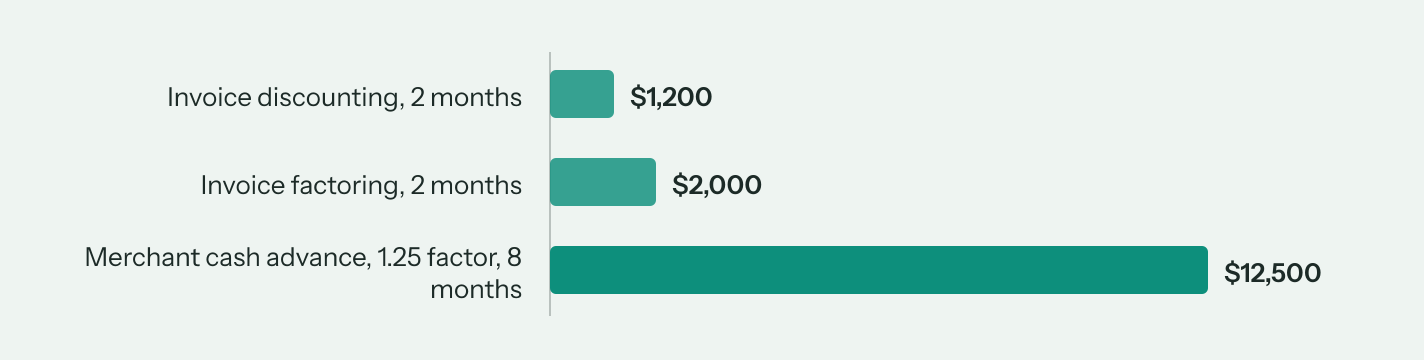
The cost is a fee on the amount advanced, expressed as a percentage per month. For example, an 80% advance on $50,000 of invoices is $40,000. A 1.5% monthly fee on that $40,000 is $600 a month, or $1,200 over two months.
Discounting suits a company with a working credit-control process. If your bookkeeping is thin, expect the provider to ask for more reporting before it advances anything.
How Invoice Factoring Works, Step by Step #
Factoring is structured as a sale of the invoices. The sequence usually looks like this:
- You sell approved invoices to the factor.
- The factor verifies the invoices with your customers and advances a large share of their value, as set in your agreement.
- Your customers are told to pay the factor directly, often into an account or lockbox the factor controls.
- When the customer pays, the factor releases the reserve it held back, less its fee.
Because customers pay the factor, they will know. For some owners that is a drawback. For others it is a benefit, because the factor takes over collections and you spend less time chasing payments.
The fee is usually charged on the invoice face value and rises the longer an invoice stays open. For example, a 2% fee per 30 days on $50,000 of invoices outstanding for two months comes to $2,000. That is roughly 24% a year on a simple basis, measured against face value. Measured against the cash you actually receive, it is higher. If the factor advances 80%, or $40,000, the same $2,000 is about 2.5% a month, or roughly 30% a year on a simple basis, before any other charges.
What Each Option Costs: Factor Rates Converted to APR #
A factor rate works differently from an interest rate. It is a flat multiplier on the amount funded, not a yearly percentage. A merchant cash advance quoted at a 1.25 factor (roughly 65–75% APR over 8 months) means you repay $1.25 for every $1.00 funded. On $50,000 that is $62,500, a cost of $12,500. The APR range is wide because repayment comes in small pieces over time rather than all at the end, so the money is outstanding for less than the full term.
Invoice fees are quoted per month, so a simple annual equivalent is easy to estimate. These are not APRs. They leave out setup fees, minimums and any compounding in the agreement.
| Option | Example | Total cost | Annual equivalent |
|---|---|---|---|
| Invoice discounting | 1.5% a month on $40,000 advanced against $50,000 of invoices | $1,200 over 2 months | About 18% simple |
| Invoice factoring | 2% per 30 days on $50,000 face value, with $40,000 advanced | $2,000 over 2 months | About 24% on face value, about 30% on cash advanced, simple |
| Merchant cash advance | 1.25 factor on $50,000 | $12,500 over 8 months | Roughly 65–75% APR |
Compare like with like: total dollars, over the same period, on the same amount. The chart shows the example fees from the table. The invoice options run for two months and the advance for eight, so it shows total cost, not a yearly rate.
Side-by-Side: Discounting, Factoring, Bank Lines of Credit and Other Options #
The table below sets the main options next to each other on speed and requirements.
| Option | Typical cost | Speed | What it needs |
|---|---|---|---|
| Invoice discounting | Monthly fee on the amount advanced | Days to weeks after setup | Sales ledger, aged receivables report, clean bookkeeping |
| Invoice factoring | Fee on invoice face value, by period outstanding | Quick once invoices are approved | Creditworthy customers, invoice verification, notice to customers |
| Bank asset-based line of credit | Variable rate (a benchmark plus the bank's margin), plus audit and setup fees | Usually weeks, after underwriting | Audited or reviewed financials, borrowing-base reports, a lien on receivables and often inventory |
| SBA 7(a) loans | Rate set by the lender within SBA limits, plus an SBA guarantee fee on many loans | Usually weeks to months | Business plan, tax returns, personal guarantee, collateral where available |
| Merchant cash advance | Factor rate, for example 1.25 over 8 months (roughly 65–75% APR) | Often one to a few days | Card or bank-statement history; not invoice-based |
A bank asset-based line of credit is a revolving loan secured by receivables and sometimes inventory. It is usually lower in cost than the invoice products, but it takes longer and asks for more documents. The SBA's 7(a) program, described on its 7(a) loans page, can fund working capital and other purposes over a longer term. It runs through a lender, with a government guarantee behind part of the loan. It is slower than invoice products and often needs collateral and a personal guarantee.
A merchant cash advance is not secured by invoices. It is repaid from a share of future card sales or bank deposits, and factor-rate pricing makes the true cost easy to underestimate. It is usually the fastest option here and the most expensive per dollar.
The Federal Reserve Banks' 2026 Report on Employer Firms, from the Small Business Credit Survey, gives context on how small firms use financing and how their applications fare. It does not replace the quote in front of you, so check current pricing against that.
Choosing Between Them, and When a Bank Line of Credit Is the Better Choice #
Choose invoice discounting if you have a finance function, your customers pay reliably, and you want to keep the customer relationship and collections in-house.
Choose factoring if you would rather hand collections to a specialist, your customers are large and dependable, and you accept that they will be told.
Choose a bank asset-based line of credit if you have time, reviewed or audited financials, and a steady borrowing base. Per dollar, it is usually cheaper than either invoice product, and you can draw on it again and again without selling receivables each time. If you qualify, it is the better tool. Don't pay factor-style fees just to avoid the paperwork.
An SBA 7(a) loans fits longer-term needs such as expansion or a larger working-capital plan, where the lender's timeline is acceptable. For equipment or real estate, the SBA's 504 program is designed for fixed assets and may be a better match than any invoice product.
Can I use invoice discounting if I already have a bank loan? #
Possibly, but read your current loan agreement first. Many bank loans and lines limit additional liens on receivables or require the bank's consent before anyone else takes a security interest in them. A discounting provider's UCC filing can conflict with a prior lender's claim on the same invoices. Ask your current lender in writing, and have the provider check the public UCC filings and your existing agreements before any funding.
What is the main difference between invoice discounting and factoring? #
The main difference is who controls the invoices and collections. In invoice discounting you borrow against invoices you still own and collect, so your customers keep paying you and usually are not told. In factoring the factor buys the invoices and collects from your customers, who are asked to pay the factor. Discounting is closer to a loan secured by receivables. Factoring is closer to a sale of them, and the pricing and paperwork follow from that difference.
Will my customers know if I use invoice discounting? #
Often not, because the arrangement can stay confidential and you keep sending invoices and taking payment on your own terms. Some providers still require notice of the arrangement, or a collection account, so the agreement will say which applies. Ask for that clause before you sign. If customers will see a third party in the payment chain, factoring is the more visible option.
How does the cost of invoice discounting compare with invoice factoring? #
Both are priced as fees, so compare them on the same basis. In the examples on this page, a 1.5% monthly discount fee on a $40,000 advance cost $1,200 over two months, about 18% a year on a simple basis. A 2% per-30-day factoring fee on $50,000 of face value, with the same $40,000 advanced, cost $2,000, about 30% a year on cash advanced. Factoring can cost more because the factor also handles collections and, in non-recourse deals, takes on customer credit risk. Discounting can cost less per dollar if your own collections are reliable. Ask each provider for total dollars over the same period, on the same amount.
Is invoice factoring the same as a bank line of credit? #
No. Factoring is usually a sale of receivables, priced by fees, with the factor handling collections. A bank asset-based line of credit is a revolving loan secured by receivables and sometimes inventory. It is priced on a benchmark rate plus a margin and stays on your balance sheet as debt. A bank line usually takes longer to set up and asks for audited or reviewed financials, but it is often cheaper per dollar if you qualify.
Where Invoice Discounting vs Factoring Fits, and Where It Does Not #
Invoice products fit when you invoice on terms, your customers pay reliably, your margin can absorb a monthly fee, and you need cash sooner than a bank can provide it. They fit less well when customers pay very late or dispute invoices, because providers will decline or charge more for that risk. They also fit poorly when you could wait a few weeks for a bank line, which is usually cheaper, or when the fees would eat most of the margin on the work you are financing. If you need money for equipment or property, an invoice product is the wrong tool.
To see these costs on your own ledger, start a request. Our network of funding partners can quote in total dollars, so you can set the results next to a bank option.
Sources #
Categories, not companies. Ranges are typical for U.S. small businesses as of the update date, not offers. How this site is paid.