The working capital formula is current assets minus current liabilities. A positive result means your business can cover its short-term bills from assets it already holds. A negative result is a gap, and it can be closed with a bank line of credit, an SBA loan, a term loan, invoice factoring or a merchant cash advance, each with different cost, speed and qualification rules.
What the Working Capital Formula Measures #
Working capital is the cushion a business has for the bills due in the next twelve months. Current assets are the things you expect to turn into cash within that year. Current liabilities are the debts and bills due within it.
Subtracting one from the other gives a single figure that shows whether short-term obligations are covered. It does not measure profit. A profitable business can still run short if customers pay slowly or if a loan payment falls due before the sales arrive.
Working Capital Formula With a Worked Example #
The formula is:
Working capital = Current assets − Current liabilities
Here is a worked example with made-up but realistic numbers for a small service business:
- Add current assets: cash $40,000, accounts receivable $60,000, inventory $25,000. Total: $125,000.
- Add current liabilities: accounts payable $78,000, loan payments due within 12 months $37,000, accrued payroll and taxes $25,000. Total: $140,000.
- Subtract: $125,000 − $140,000 = −$15,000.
The result is a $15,000 shortfall. The business has $15,000 less in near-term resources than it owes in the same window. Use the figures from your own balance sheet; the formula does not change.
How to Read a Positive or Negative Result #
A positive result means current assets cover current liabilities. That is a cushion, and it is the first thing a lender or supplier will look at.
A negative result means a gap. In the example above, the business would need about $15,000 more in cash, or in receivables collected early, to pay everything due in the year without strain.
Direction matters as much as the single number. Calculate the figure at the same point each month and watch the trend. A small negative that is shrinking is easier to manage than a larger one that is growing.
Common Mistakes When Calculating Working Capital #
- Counting long-term assets. Equipment, vehicles and property usually belong outside current assets unless you expect to sell them within a year.
- Counting weak receivables at full value. An invoice that is months overdue or from a customer who may not pay should be discounted or left out.
- Leaving out the current portion of debt. Any loan principal due within twelve months is a current liability, even if the loan is long-term.
- Forgetting accrued items. Unpaid payroll, sales tax and card balances are easy to miss and are often due quickly.
- Using one day's balance. Cash moves daily. Use a month-end figure and compare it with a forecast of the next three months.
Funding Options to Close a Working Capital Gap, Side by Side #
When the result is negative, the question becomes how to fund the gap at a cost you can carry. Costs are not quoted the same way across products, so compare them on one basis.
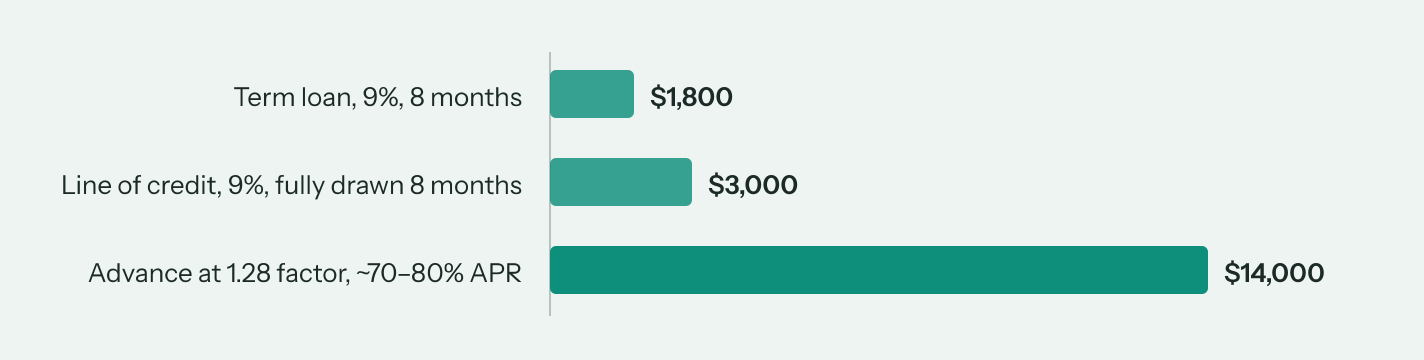
Banks and SBA lenders quote an interest rate. Merchant cash advances quote a factor rate, which is a multiplier on the amount funded. A 1.28 factor on $50,000 (roughly 70–80% APR when repaid over 8 months) means $64,000 is repaid, a $14,000 cost. Because the balance is repaid in pieces over a shorter time, the APR equivalent is an approximation that changes with the repayment speed, so always convert before you compare.
| Option | Typical cost | Speed | What it needs |
|---|---|---|---|
| Bank term loan | Interest rate set by the bank. For example, about $1,800 in interest on $50,000 repaid over 8 months at 9% | Usually weeks, because of underwriting | Tax returns, financial statements, a credit review and a cash-flow test |
| SBA 7(a) loans | Rate capped under SBA rules and set with the lender. Terms run longer than most short-term products | Commonly a month or more | Eligibility under SBA rules, lender underwriting and usually a personal guarantee |
| Credit lines for businesses | Interest on the drawn balance only. For example, $50,000 fully drawn for 8 months at 9% is about $3,000 in interest | Days to weeks once the line is open | A credit history, time in business and bank statements |
| Merchant cash advance | Factor rate. A 1.28 factor on $50,000 is $64,000 repaid, about 70–80% APR over 8 months | Often within days of a complete application | Card sales or deposit history; repaid from a share of daily sales |
| Invoice factoring | A fee on the invoices sold, which varies with invoice age and the buyer's credit | Often days after invoices are verified | Invoices owed by customers who can pay |
For factoring, the difference between selling invoices and borrowing against them matters. invoice discounting vs factoring explains who collects and who carries the risk.
SBA 7(a) loanss can be used for working capital, and the SBA's 7(a) page explains the uses, maximum amounts and the lender's role. Bank and SBA products take longer to close, but they usually cost less per dollar than a factor-rate advance.
The Federal Reserve's Small Business Credit Survey tracks how often small firms apply to and are approved by each lender type, which is a useful check on how these options compare in practice.
California's commercial financing disclosure rules, in effect since late 2022, require a provider to give a signed disclosure of total dollar cost, term and an annualized rate before an offer is final. Ask any provider for those figures in writing.
Is Negative Working Capital Always a Bad Sign? #
No. Some businesses collect cash before they pay suppliers, such as those that take payment upfront or at the register. For them a negative figure can be normal.
The question is whether the gap is temporary and whether the cash will arrive in time. A negative figure that grows for several months, or one caused by unpaid taxes or a loan that cannot be refinanced, is a warning sign that deserves action.
What Counts as a Current Asset or Current Liability? #
Current assets include cash, accounts receivable you expect to collect within a year, inventory and prepaid expenses such as insurance paid in advance.
Current liabilities include accounts payable, credit card balances, accrued payroll and taxes, and the portion of any loan due within twelve months. Equipment, property and the long-term part of a loan sit outside the calculation.
How Much Working Capital Should a Small Business Have? #
No single number fits every business. The right level depends on how quickly you get paid, how long you wait for customers to pay and how seasonal your sales are.
A practical test is whether cash on hand plus expected collections covers payroll, supplier bills and loan payments through your slowest month. If it does, the cushion is probably adequate. If it does not, you have a gap to plan for before it arrives.
How Is the Cost of a Merchant Cash Advance Compared With a Bank Loan? #
Convert both to the same basis. A bank loan quotes an interest rate. A merchant cash advance quotes a factor, so a 1.28 factor (roughly 70–80% APR over 8 months) on $50,000 is $64,000 back, a $14,000 cost.
For the same $50,000 repaid over 8 months at 9%, a bank term loan costs about $1,800 in interest. The gap in cost is real, and it is why bank and SBA money is the cheaper choice when you qualify and have time. Also check the prepayment terms, because they decide whether paying early saves you money.
Which Funding Option Is Fastest When Working Capital Runs Short? #
Merchant cash advances and invoice factoring can often fund within days once the paperwork is complete. A line of credit can be quick if you already have one open. Bank term loans and SBA 7(a) loanss usually take weeks or months, because the lender must underwrite the file.
Speed depends on the lender and on how complete your application is. Ask for the timeline in writing, and ask what documents will be needed before the clock starts.
Where Each Option Fits Your Gap, and Where It Doesn't #
A bank line of credit fits a gap that comes back each season and that you can qualify for. You pay interest only on what you draw, which makes it one of the lower-cost options per dollar. If you cannot qualify, it is not available.
An SBA 7(a) loans fits a need you can plan for, where you can wait and where longer terms help. SBA guarantees part of the loan, which can make it easier for a bank to say yes, but the process takes time.
A bank term loan fits a one-time need with a known payback. A lender will test whether your cash flow covers the payments, and what is a debt service coverage ratio explains how that test is calculated.
A merchant cash advance fits a short gap when you cannot qualify for bank money in time and you can absorb a daily share of card sales going to repayment. It does not fit thin margins, and it does not fit a business whose losses are recurring. Borrowing does not fix a model that does not cover its costs.
Invoice factoring fits a gap caused by unpaid invoices from customers who can pay. It does not fit a gap caused by slow sales.
Ready to compare real offers against your own numbers? Start your request.
Sources #
This article is a general overview; it does not give advice for your situation. Nothing applies to you except the terms written in an agreement you sign. How this site is paid.